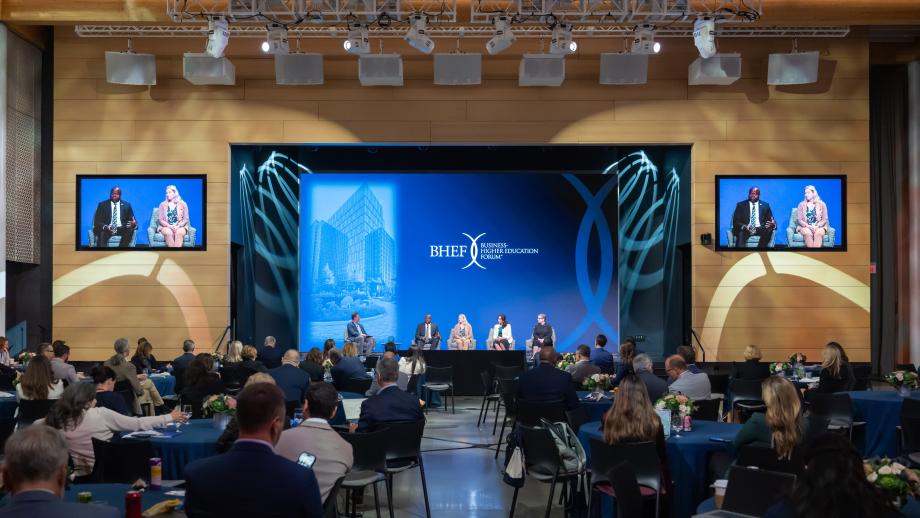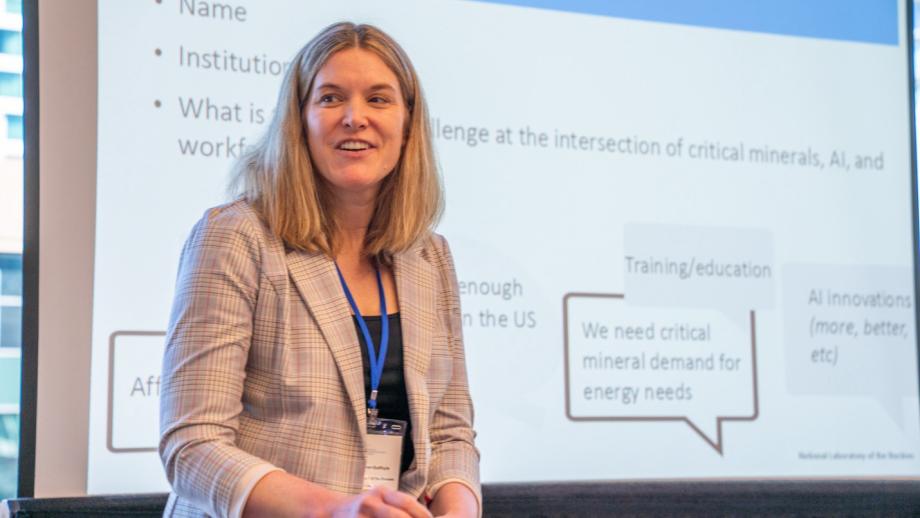
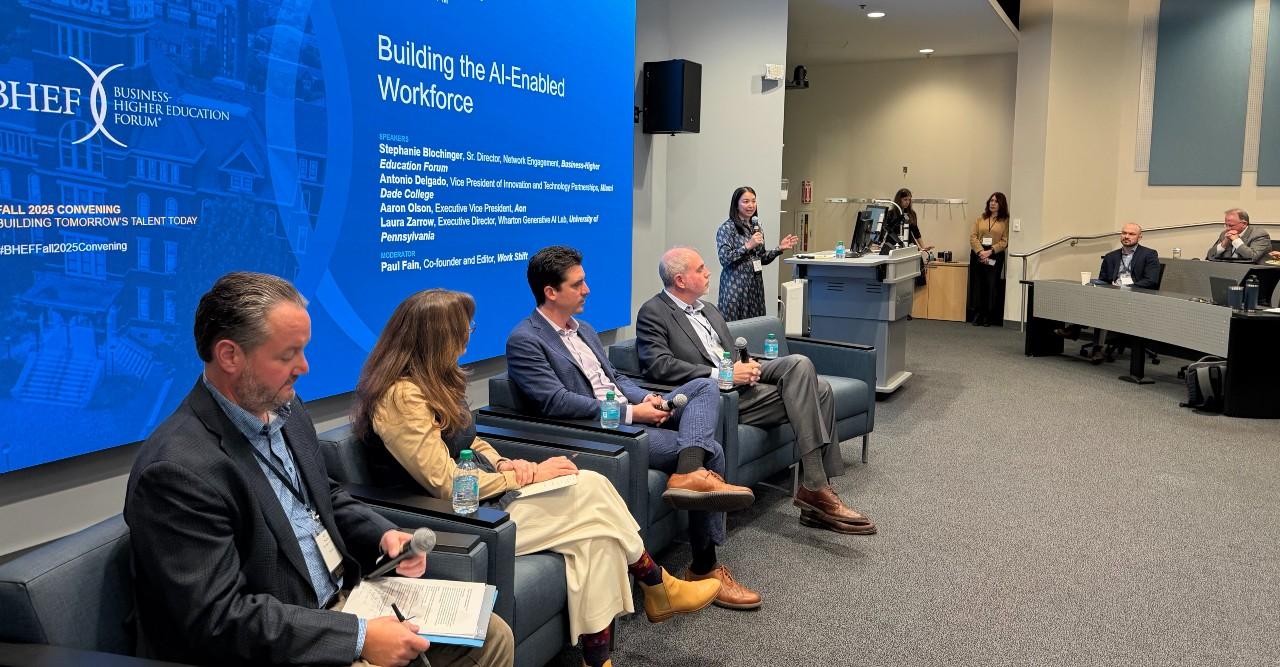
Much of 2025’s public conversation about artificial intelligence focused on job loss. Yet at the Business-Higher Education Forum’s Fall 2025 Convening, hosted by Georgia Tech President Ángel Cabrera, leaders from business, higher education, philanthropy, and government emphasized a different reality.
AI is not eliminating work. It is transforming every job, reshaping roles and skills at a speed most organizations are still trying to comprehend. With more than 150 million workers likely to require some level of AI upskilling in the coming years according to leaders at the event, the central challenge is not displacement: it is readiness.
Leaders agreed on another critical point: no sector can navigate this shift alone. As the AI Workforce Consortium reported in October 2025, AI skills have reached a critical inflection point, with nearly four out of five information and communications technology roles requiring some form of formal AI skills. Addressing this rapid growth requires a new kind of partnership between business and higher education rooted in co-design, shared data, and continuous learning rather than linear talent pipelines.
Across two days of cross-sector collaboration in Atlanta, four themes came into clear focus.
1. Work is changing faster than anyone expected
Executives described a labor market already reshaped by AI. The question is no longer whether AI will alter work: it already has. The urgent task now is helping people thrive in redefined roles.
An executive from the AI Workforce Consortium put the shift plainly. In the era of AI, “every role will become a human role, even as jobs become more technologically advanced.”
AI elevates the importance of durable, human capabilities: communication, judgment, collaboration, creativity, and problem-solving. Technical skills matter, but these human skills determine who can adapt as tasks evolve.
As Aaron Olson, Executive Vice President at Aon, emphasized, “Durable skills are what’s left when jobs are automated.”
To support this shift, leaders discussed how they are increasingly relying on tools like BHEF’s AI-Enabled Professional Framework, which uses the insights of more than 100 business and education leaders exploring AI skills shifts to provide a shared vocabulary for assessing competencies across career stages. Rather than cataloging static skills, the framework helps institutions and employers set priorities for a workforce that must continually evolve.
2. Business and higher education are learning, and innovating, together
Leaders were unequivocal: traditional employer–higher education dynamics cannot keep pace with AI. Employers cannot simply “signal” their needs, and colleges cannot build programs around static job descriptions. The age of AI requires parallel learning, continuous employer input, and new models of experiential education.
Or, as Ryan Oakes, Global Health and Public Services Practice Chair at Accenture and a BHEF Board Member, put it:
“AI is the ultimate change-management project. Organizations need to evolve and use humans to drive continuous change.”
The shift is already visible in new talent models:
- Zurich Insurance anticipated talent shortages a decade ago and built degreed apprenticeships to “grow their own” workforce. These programs expand access to historically overlooked talent while allowing apprentices to earn competitive wages and two- or four-year degrees. Tuition is covered by their employer as part of their career progression. As Bühler N.A., which also practices the degreed apprenticeship model with BHEF Network Partner Wake Tech Community College noted, the technical skills and investment required to train employees means the model just makes business sense for them.
- Intel and Miami Dade College co-developed stackable, industry-aligned credentials that prepare adult learners, more than 60% over age 26 and employed, to gain AI-ready skills without stepping out of the workforce.
- And Georgia Power and Georgia Tech forged a deep partnership to prepare engineers, technicians, trades workers, and policymakers for rising energy demands driven by AI infrastructure growth.
In each case, employers and institutions embraced co-creation, the idea of shared data, shared uncertainty, and shared accountability to build AI-ready talent pipelines.
3. BHEF’s leaders are focused on asking the right questions to address the right opportunities
If the public debate remains fixated on whether AI will eliminate jobs, leaders at the convening urged a more constructive perspective: how do we prepare people for jobs that AI is already reshaping?
As Miami Dade College’s Antonio Delgado offered one of the most resonant insights of the week: “People may not lose their jobs to AI, but people will lose their jobs to people who know how to use AI.”
This shift demands new thinking from both educators and employers. Colleges must build curricula that integrate ethical reasoning, human–AI collaboration, and experiential learning. Employers must view training not as a discretionary benefit but as a strategic investment for their competitiveness. And both must create environments where people can experiment, learn, fail safely, and grow.
Leaders also emphasized the cultural dimensions of AI adoption: governance structures, leadership practices, and organizational norms must adapt as rapidly as the technology itself. AI changes workflows, but it also changes expectations for trust, creativity, and collaboration.
4. We have to address regional disparities today, before they grow faster than we can tackle them.
One of the most pressing and underappreciated dimensions of the AI workforce challenge is regional readiness. According to our experts, AI-intensive jobs are clustering in a handful of metros and are commanding a 55% wage premium. Without intervention by leaders like ours, regions without strong talent ecosystems risk falling further behind.
Community colleges are already seeing rising demand from working adults seeking AI-aligned upskilling close to home. States like Louisiana and Georgia demonstrated how coordinated regional strategies that link employers, higher education, workforce agencies, and economic developers can reposition local economies for AI-era growth.
Our philanthropic leaders, representing hundreds of millions of dollars of investment, reinforced the stakes. Despite ten million more Americans holding postsecondary credentials than a decade ago, too many credentials today lack labor-market value, especially in regions without strong employer alignment. The proliferation of AI skills and credentials will only accelerate confusion in the marketplace for businesses, workers and learners, and educators.
Closing equity gaps requires addressing two challenges simultaneously: removing barriers to completion and building institutional capacity to identify and scale high-quality credentials and programs. In an era of massive disruption to public funding, regions will need to identify how they can better use philanthropic capital to drive local, non-federally funded solutions.
For the nearly 40 million adults with some college and no degree, regional quality and institutional readiness often determine whether AI expands opportunity or deepens exclusion. AI readiness is, at its core, a regional issue. Without intentional ecosystem building, the benefits of AI will remain concentrated rather than broadly shared.
A call to action: shaping the AI-enabled economy together
As the convening closed, leaders reflected on a simple truth: we are choosing, in real time, what kind of AI economy the United States will build.
Philanthropy cannot replace public investment, but it can accelerate innovation. Leaders from Lumina, Strada, ECMC Foundation, and the Gates Foundation emphasized the conditions required for effective cross-sector work: clarity of goals, shared definitions, aligned metrics, and the humility to learn together. Throughout this transition, strong leadership will remain key. As one funder put it: “We support strong leaders, not just strong projects.” The role of philanthropy as ecosystem R&D partners, able to convene, de-risk pilots, and build trust, will be essential as communities test new approaches to talent development.
This perspective, the idea of trust being a more critical underpinning than ever, reinforced the central theme of the convening: building an innovative, equitable, AI-enabled economy requires collective leadership from business, higher education, philanthropy, and government. What emerged in Atlanta was not fear of disruption but a shared commitment to meet this moment with clarity, urgency, and collaboration.
BHEF will continue driving this work: convening leaders, developing actionable tools, and strengthening partnerships that build high-quality, inclusive pathways. We look forward to continuing this momentum at our Spring 2026 Convening hosted by President Michael Crow of BHEF Network Partner institution Arizona State University.