
The skilled trades are on the cusp of significant growth, driven by demand across industries like manufacturing, utilities, construction, and transportation. By 2034, advanced manufacturing and production (+200,000 jobs), installation, maintenance, and repair (IMR) (+450,000 jobs), and construction (+500,000 jobs) occupations are projected to add over a million new jobs. Semiconductor technician roles, driven by CHIPS Act investments, are expected to grow 13 percent. IMR jobs are expanding across sectors like energy, healthcare, and automotive.
Critical Supply-Demand Pressures:
But this future isn’t guaranteed. Demographic shifts, declining male workforce participation, and uncertainty around federal funding and policies pose serious risks to meeting this demand.
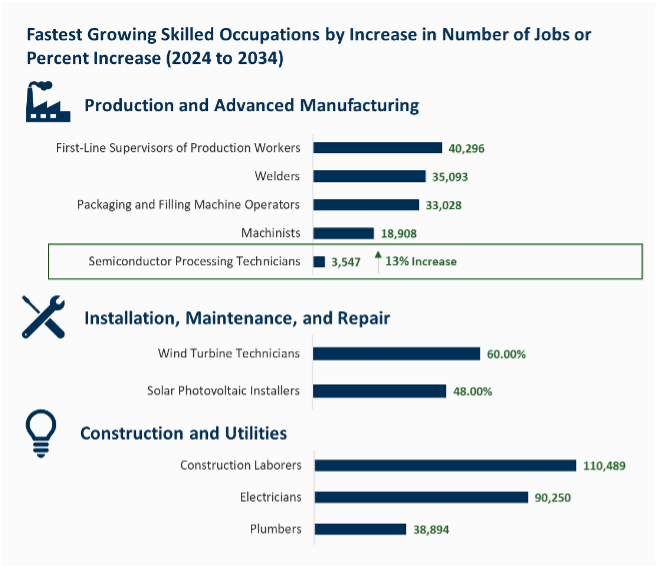
Image: BHEF Analysis of Lightcast and Bureau of Labor Statistics Data
Historically, many skilled trade occupations have relied heavily on male workers, but recent trends reveal several alarming signals:
- Labor participation for men ages 25-54 has fallen dramatically
- Male college enrollment and degree completion are also down nationwide, even in associate degree programs tied to fields like advanced manufacturing.
- Retention risks for skilled trades are high: McKinsey projects that very few workers will remain in their skilled trade roles by 2032, further complicating workforce supply.
The CHIPS Act promised to spur job growth in semiconductor manufacturing and production while increasing training opportunities. But political uncertainty and potential pauses in funding could limit these gains, reducing both the demand for talent and the infrastructure needed to train workers.
Building a Resilient Talent Pipeline
The question is no longer just about how much these occupations will grow, it’s about whether we’ll have the workforce to fill these roles. Meeting this challenge will require coordinated action:
- Expand and Diversify the Talent Pool: Recruit more women and underrepresented groups while addressing declining male enrollment and completion rates. Partner with groups like Chicago Women in Trades that offer free hands-on training, pre-apprenticeship programs, and a community for women in the trades.
- Market Skilled Trades Differently: Highlight career opportunities, economic mobility, and the high wages associated with these roles to better attract talent.
- Expand On-the-Job Training (OJT): Develop innovative new or expand existing OJT models that address challenges and increase the number of people gaining experience early on. Customized training to address unique skillsets, using emerging technologies to address training challenges, and partnering with associations or intermediary organizations are a few ways OJT can be expanded.
- Plan for Funding Shifts: Identify multiple funding streams, including those outside of federal funding, to make training programs sustainable and to increase community college capacity to train for these roles.
The skilled trades are poised for transformation. Without action, we risk falling short of the workforce needed to sustain industrial growth and support essential services and infrastructure that Americans rely on daily.