
Businesses are navigating rapidly changing skill needs and with that, the pressure to adapt their recruitment approaches and upskill current employees to meet those needs. Businesses have critical insight into how jobs are changing but they often don't have the capacity to build and scale talent training solutions on their own.
Higher education brings that expertise and can build learning experiences, develop well-rounded talent, and deliver education at scale. But to do so, they need business at the table to understand how skills are changing and ensure programs prepare learners for real and upcoming opportunities.
The persistent challenge? Business and higher education speak different languages. For example, a business might open an email from a higher education partner and see several opportunities to engage: join an advisory board, speak to a class, provide internships, review curriculum, attend an event, and maybe hire some students, too. They may genuinely want to partner but be unsure where to start or which opportunity best aligns with their needs.
On the other side, higher education knows businesses have competing priorities and limited capacity. They may feel like they have a limited window to capture a business’s attention, so they try to communicate everything the institution can offer at once.
The result is a familiar paradox: both sides want to partner, but the first conversation can make partnership feel like an uphill battle. This is where a partnership pitch can help.
Give Businesses a Reason to Keep Talking
A partnership pitch isn’t a script that everyone at an institution needs to memorize. It’s a shared set of messages that answer a few fundamental questions:
What is the institution’s competitive advantage?
What problems can it help businesses solve?
What does partnership look like?
What is a clear, easy way for a business to get started?
These messages can be adapted for nearly any business engagement setting or industry context: a one-on-one conversation, outreach email, introductory meeting, one-pager, slide deck, website, or even an unexpected conversation with a business partner at an event. The goal of a partnership pitch isn’t to communicate everything at once. It’s to give a business just enough information to understand the value of and how to continue the conversation.
Five Reasons Every Institution Can Benefit from a Partnership Pitch
Create consistency across an institution: Employer engagement rarely sits with just one person or department at an institution. Faculty, career services, workforce teams, advancement staff, deans, presidents, and others may all interact with business partners. A partnership pitch gives those individuals a common foundation to pull from. The conversation can, and should, change depending on the business, but the core message stays consistent.
Make messaging clear and concise: Businesses want to quickly understand: Why should I care? What could we accomplish together? What would you need from me? Developing a partnership pitch helps an institution think through those questions, prioritize what matters most, articulate the value it can bring to a business partner, and focus the message on what the business needs to know to take the next step.
Put the institution in the employer’s shoes: Building the pitch itself can be just as valuable as using it. The process of customizing the pitch gives faculty and staff a structure for thinking about partnership from the business perspective: What is the business challenge? How could the institution help address it? What value does the business gain from the time and resources it invests? Working through these questions helps build the habit of approaching employer engagement from the business perspective; helping shift engagement from a series of transactions to a more sustainable, mutually beneficial partnership.
Be ready when an opportunity arises: Not every partnership begins with a formal meeting. It might start when a faculty member meets a business leader at an event, a dean hears about a company’s talent challenge, or an existing partner mentions a new need. Having core partnership messages in place gives faculty and staff a foundation they can draw from in those moments. Rather than developing a message on the spot, they have clear language, relevant examples, and potential next steps that can be adapted to the business and conversation at hand.
Get clearer about institutional capacity: Institutions often want to say yes when a business is ready to engage. But a strong partnership also requires being realistic about what the institution has the capacity to deliver. Developing a partnership pitch creates an opportunity to define what types of partnerships are feasible, what resources and staff are needed to support them, and what the institution can reasonably commit in return. This clarity helps protect staff time and capacity and focus resources on partnerships the institution can deliver well and sustain over time.
Partnership Pitches in Practice
While a partnership pitch should be customized to each existing or prospective business partner, there are a few core elements institutions can draw from to build a strong message. For more guidance, see the “How to Partner with Us Pitch Deck Checklist” on page 18 of BHEF’s Industry Partnerships that Last: A Playbook for Higher Education.
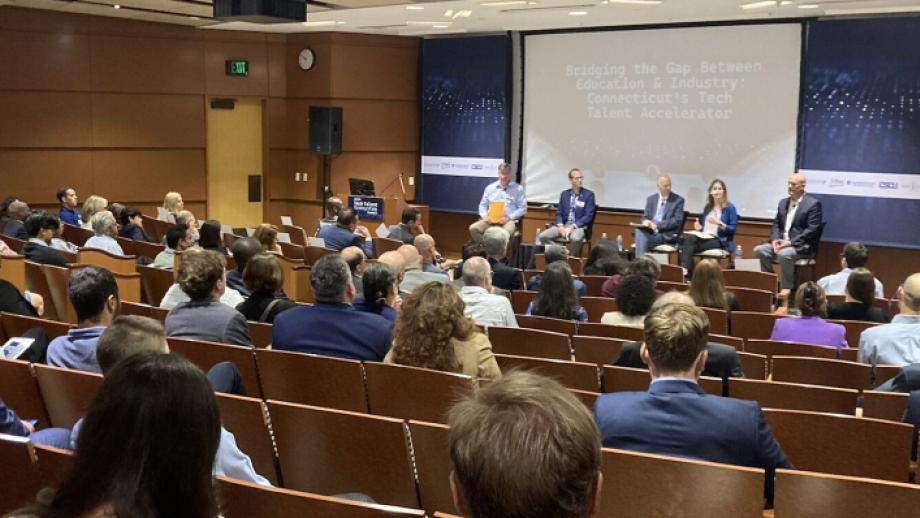
We saw the value of this exercise firsthand during a recent BHEF Connecticut Tech Talent Accelerator (TTA) Community of Practice meeting, where grantees developed and shared their own partnership pitches. The exercise pushed institutions to clarify what they were asking of businesses, articulate the value they could offer in return, and make the path to partnership more clear.
Below are the core elements of a strong partnership pitch, along with examples of how TTA grantees put them into practice.
Institutional Overview: Who you are, who do you serve, what is your competitive advantage, and why it matters to business.
The University of New Haven tailors its pitch to a large regional business with cybersecurity and technology talent needs, highlighting the institution’s particular strengths in developing cyber talent and making a clear case for why it could be the business’s go-to talent partner: “The University of New Haven – an NSA -designated Center of Academic Excellence in Cyber Operations– has spent a century preparing diverse STEM graduates for regional and national workforce demands. We were among the first institutions to launch dedicated AI degrees and our new institutional AI Action Plan makes AI literacy and integration a university-wide priority.” Why Partnership Matters: The shared challenge: What workforce or talent challenge can you address together?
Why Partnership Matters: The shared challenge: What workforce or talent challenge can you address together?
Fairfield University is a leader in nursing training, Egan School of Nursing and Health Sciences named a center of excellence since 2018, and credible partner in the region. They use a compelling data point to quantify the shared challenge and connect the program directly to potential cost savings for a prospective healthcare business partner: “Healthcare employers are currently facing a significant talent gap as the rapid integration of AI outpaces the availability of clinicians trained to use it, specifically in areas like clinical decision-support interpretation, workflow automation, and data literacy. This challenge is exacerbated by the fact that nurses currently spend approximately 25.6% of their working hours on documentation—a process that is often redundant and inefficient, leading to increased overtime costs and reduced bedside care. Employers cannot solve this problem alone...”
History of Impact: What's an example of a successful employer partnership? What problem did you solve, and what changed as a result?
The University of Saint Joseph grounds its pitch in its longstanding partnership with CGI, using examples from the partnership to illustrate each element of the pitch: “whenever they identify new urgent workforce needs, we meet again and quickly update our curriculum. In response to their most recent feedback, we are...” By showing how the relationship grew over time and the value it created for both partners, the institution brought its partnership approach to life with a real-world example.
ROI for Business Partners: What does the business gain from investing its time and expertise?
Quinnipiac University does this particularly well in a partnership pitch developed as a one-pager. Rather than asking businesses to “engage in project-based learning,” Quinnipiac framed the opportunity around what a business could gain: “test real-world use cases: engage students and faculty in applied research, workflow analysis, data projects, and responsible AI implementation challenges”. This intentional shift reframes the ask around the value and potential return for the business partner.
Partnership Activities: What are a few concrete ways employers can participate, and what is the value to them?
The University of Connecticut makes it easy for business partners to identify the right partnership activity based on their goals and capacity by offering three tangible and easy to understand levels of engagement: “At a low-touch level, employers can provide input on priority AI skills...at a moderate level, employer can help co-design applied assignments...at a deeper level, employers can identify cohorts of incumbent workers for upskilling...” This approach demonstrated that engagement at any level is valuable while giving businesses space to be transparent about their capacity.
Partnership Stakeholder Roles: What will your institution own, and what do you need from the employer?
Southern Connecticut State University demonstrates its flexibility as a partner, showing how it can adapt talent solutions to meet the needs of different learner groups such as employees with shift based schedules on the manufacturing floor, that require flexibility: “Based on employee and manager feedback, SCSU adapted the program from fully synchronous online delivery to a HyFlex model, allowing production employees to participate despite workforce scheduling challenges. Instructors refined content, reordered training, and provided additional support to ensure learning outcomes were achieved.”
Next Step: What's the simplest action to keep the conversation going?
Connecticut College ends its partnership pitch with a clear, low-lift ask that gave the prospective business partner an easy next step while leaving the door open to explore a range of opportunities. Rather than prescribing how the business should engage, Conn College first invited the partner to share its needs, ensuring that future partnership opportunities could be shaped in response to the business’s priorities: “The return on investment for you is a direct pipeline of elite talent that is already trained in the ethical, high-level AI implications you need, reducing your onboarding time and positioning your organization as the thought leader shaping the next generation of finance. My ask is a 20-minute conversation to look at our current progress and see where your insights could have the most impact.”
From a Pitch to a Partnership
A partnership pitch is more than a tool for starting a conversation. The process of developing one helps institutions get clearer about the value they bring, consider partnership from the business perspective, and create a shared approach to employer engagement. And when the right opportunity arises, it gives faculty and staff a strong foundation to build from. The pitch may open the door, but the goal is what comes next: a partnership built around shared needs, mutual value, and a reason for both sides to keep coming back to the table.
See a partnership pitch in action and check out the pitch videos from our Tech Talent Accelerator Pilot grantees (shared above or view the playlist on YouTube here). The Tech Talent Accelerator, funded by the Connecticut Office of Workforce Strategy, provides support to institutions across the state to build AI skills pathways and partnerships. To learn more, check out the website.