The U.S. economy is evolving rapidly, driven by technological change, demographic shifts, and the emergence of new sectors like AI. As skill needs change faster than traditional education and workforce models can adapt, learners are increasingly seeking options that connect more directly and quickly to work. At the same time, employers, colleges, and states are grappling with how to respond in ways that expand opportunity and maintain quality.
Short-term, nondegree credentials are one important part of this response—but they are not a replacement for degrees. Instead, short-term credentials are most effective when embedded in a broader, aligned system that includes certificates and associate and bachelor’s degrees, and clearly articulated pathways between them. For example, a student might earn a CNC machinist certificate at a local community college, gain immediate access to good-paying jobs, and still apply those credits toward a future AAS or BS degree. Likewise, a student interested in the tech sector could complete high-demand IT certifications from CompTIA or AWS, qualify for an entry-level role, and continue on a pathway toward a cybersecurity degree that leads to management opportunities. When driven by real labor-market demand and validated by employers, short-term credentials can help learners enter or advance in the workforce while preserving long-term mobility.
Yet the growth in short-term credentials has also introduced confusion. The central challenge is no longer whether they should exist, but how states, institutions, and employers can confidently identify and invest in those that truly deliver value.
These questions sit at the core of FutureReady States, a twelve-state initiative supported by the Lumina Foundation. The effort is focused on bringing greater clarity, transparency, and alignment to the short-term credential landscape so that learners, policymakers, institutions, and employers can make informed decisions about where to invest time, funding, and trust.
Momentum Without Alignment
Today, more than 1.5 million non-degree credentials are offered across the U.S., with states investing over $8 billion annually. This growth reflects genuine workforce need—particularly in fields such as healthcare, advanced manufacturing, and technology, where employers face persistent talent shortages and cannot rely solely on traditional degree timelines. Research shows that some short-term credentials lead to meaningful wage gains and can serve as accessible on-ramps for new learners.
At the same time, outcomes vary widely. Returns differ by field, demographic group, and credential type, and many credential holders already have an associate degree or higher—raising questions about signaling, duplication, and long-term value. Without clearer standards and shared definitions, the market risks being shaped by the desire to create shorter options rather than by demonstrated employer demand.
What It Takes to Define “Value”
Since July, teams from twelve states have been working through FutureReady States to bring greater coherence to their short-term credential ecosystems. The Business-Higher Education Forum (BHEF) is providing technical assistance to Connecticut, New Jersey, and Texas, drawing on our national network of leading employers, institutions, systems, and intermediary partners.
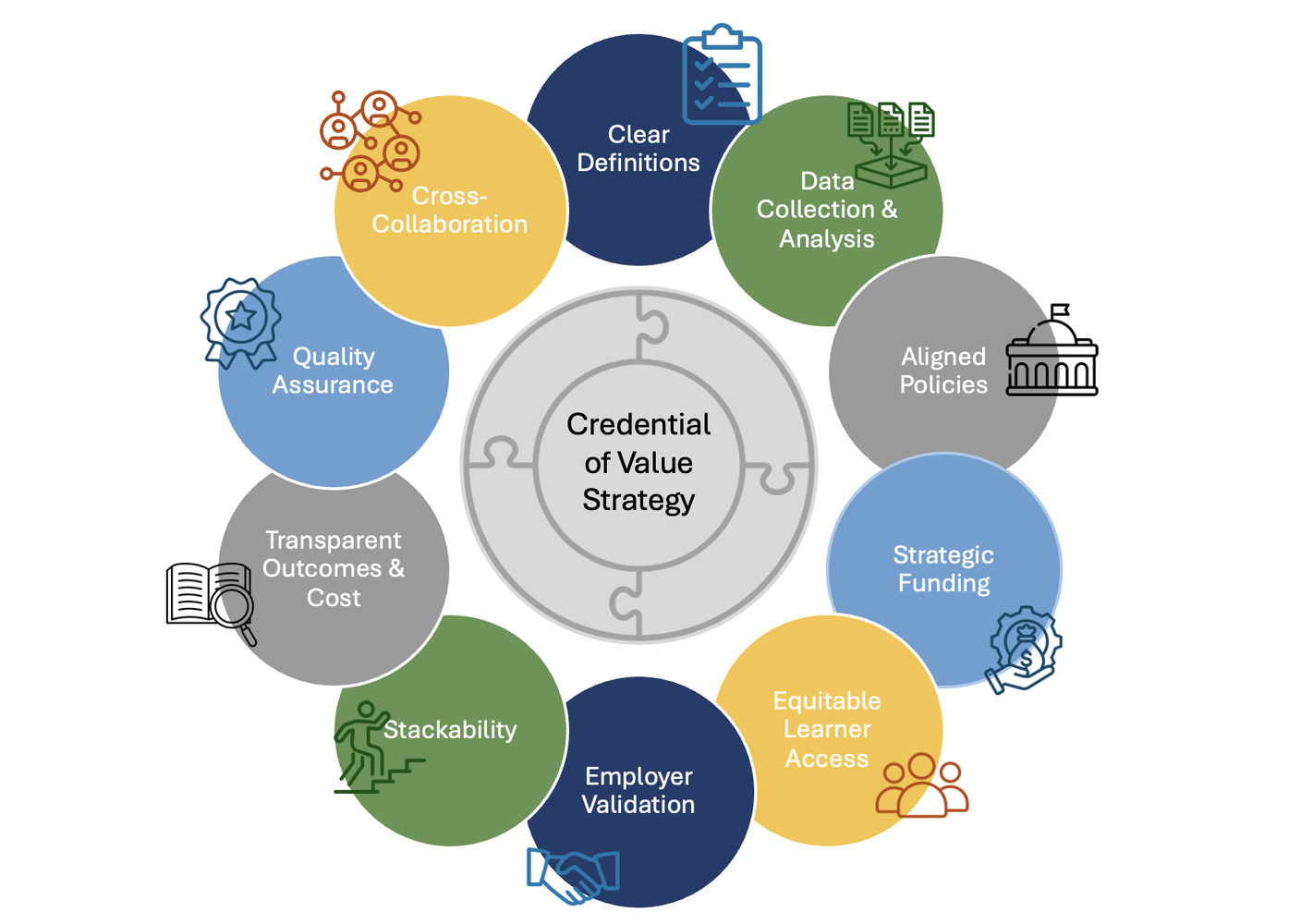
Across this work, BHEF finds that ten core elements consistently emerge as essential to create a credential of value:
- Clear, consistent definitions of what constitutes a credential of value
- Strong data collection and analysis on key credential components (ex: transfer, employment, and wages)
- Aligned policies that provide clear structure and oversight
- Strategic and sustainable funding sources
- Equitable access for all learners
- Employer validation and labor-market alignment
- Stackable pathways connected to degrees
- Transparent outcome and cost information for students
- Quality assurance measures
- Cross-agency and cross-sector collaboration to maintain alignment
Together, these elements advance a key priority that the businesses and colleges in the BHEF network share: increasing the number of learners and earners with high-value skills and credentials aligned to employer needs. No single element is sufficient on its own. Progress requires coordinated action across education, workforce, and industry systems—and sustained employer engagement to ensure credentials reflect real skill needs, not just shorter timeframes.
From Growth to Coherence
The time is right to unlock the potential of short-term credentials through greater clarity, cross-system coordination, and stronger alignment from classroom to career—and BHEF is honored bring its expertise and experience to this critical work. We will continue this work alongside FutureReady States partners and national collaborators—Century Foundation, Jobs for the Future, ESG, and National Skills Coalition. As we continue to learn, we are committed to sharing key lessons, elevating promising approaches, and translating complexity into actionable guidance for our network, our partners, and the broader field.
Short-term credentials are here to stay—and that is a yes, and opportunity. Yes to faster entry points into good jobs, and to long-term mobility. Yes to innovation, and to quality and accountability. Yes to access, and to employer-driven relevance. Yes to degrees and to stackable short-term credentials.
Together, we can help the field move from fragmentation to alignment—ensuring that short-term credentials are designed not simply to be shorter, but to be meaningful, trusted, and connected to real opportunity.