Are Bachelor’s Degrees Losing Their Importance in Recruiting?

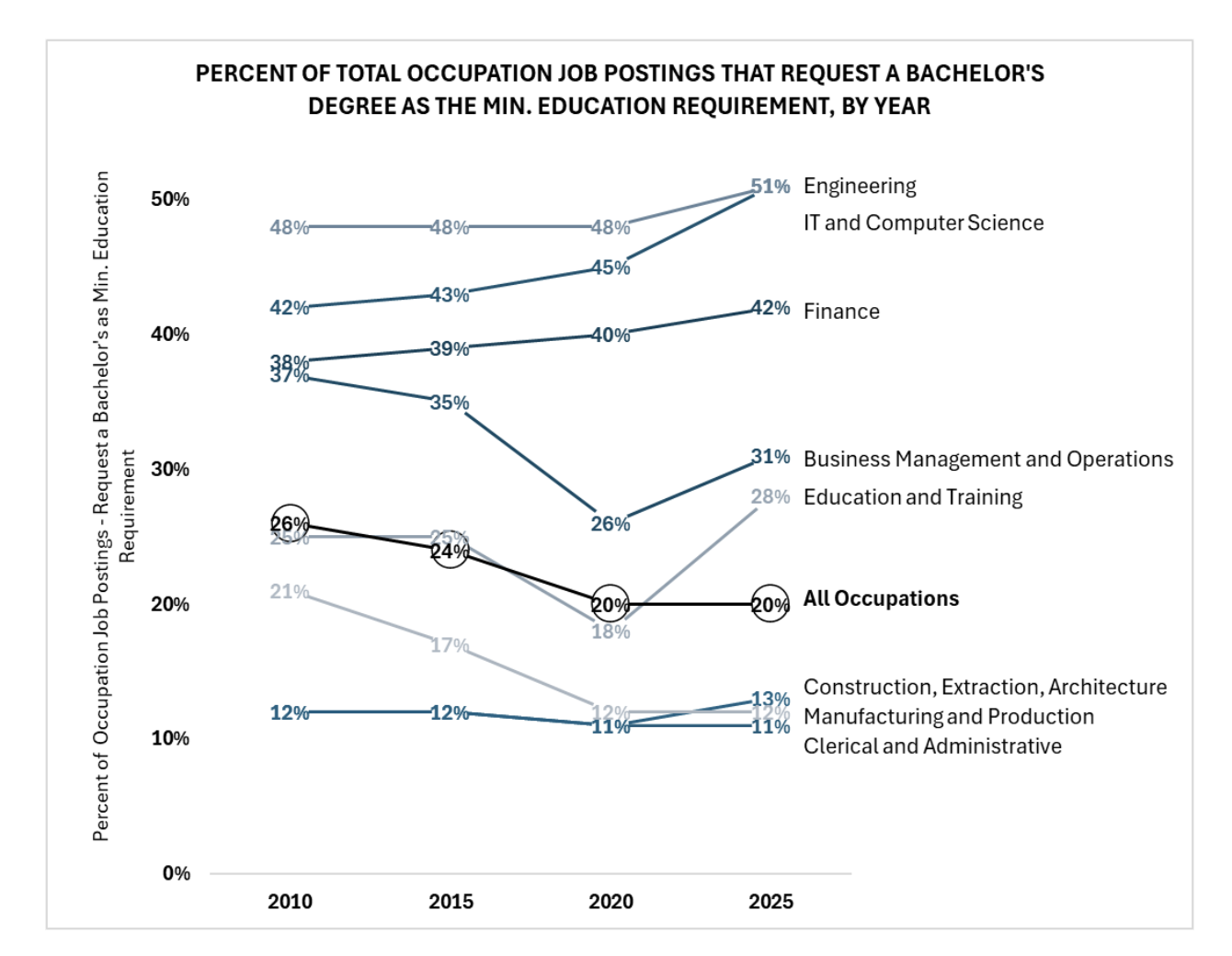
State governments and companies claim to be moving away from degree requirements, but what do labor market trends reveal? Overall, postings over the last ten years show that across all sectors and roles, the degree is being cited less frequently as a requirement in job postings. Our analysis of job postings shows differential dynamics across sectors and occupations: 

Declines in Degree Requirements: Fields like manufacturing and production show a steady drop in degree requirements since 2010. For instance: 

  • Production Managers: 39% of postings require a degree (2010) → 28% (2025) 
  • Machine Operators/Technicians: 6% (2010) → 2% (2025) 

Consistency in Non-Degree Fields: Occupations like clerical/administrative and construction have maintained stable, low degree requirements (~11%) for over 15 years. 

Growth in Degree Demand: High-paying fields like IT, Finance, and Engineering continue to increase their share of jobs requiring bachelor’s degrees in postings, despite pronouncements otherwise. 

Takeaway: While degree requirements remain vital for many lucrative careers, automation and changes in job demand are reshaping expectations in certain fields. We’ll be tracking the impact of skills-based approaches and AI and supporting our partners in aligning skills and industry needs. 
More from Bridging Business and Education

The AI Workforce Moment Is Here: Here Is How Business and Higher Education Are Leaning in Together

AI is not eliminating work. It is transforming every job, reshaping roles and skills at a speed most organizations are still trying to comprehend. With more than 150 million workers likely to require some level of AI upskilling in the coming years according to leaders at the event, the central challenge is not displacement: it is readiness.

Work-Integrated Learning Takes Center Stage at Business-Higher Education Forum Fall Convening

Work-integrated learning is emerging as essential infrastructure for preparing talent, and leaders at BHEF’s 2025 Fall Convening highlighted how apprenticeships, internships, and real-world projects are helping students meet the pace of today’s evolving workplace.

Corporate Leaders Challenge the Field to Reimagine Work, Not Just Retool It

What if AI readiness isn’t about retooling workers, but reimagining work entirely? Advisors from BHEF’s AI and Future Talent Collaborative share why traditional workforce planning can’t keep pace—and what will.

Future-Proofing Talent in an AI-Powered World: A Sharp Competitive Advantage

As the pace of AI transformation accelerates, organizations across every sector grapple with the same fundamental question: How do we prepare our people to thrive alongside artificial intelligence? From marketing to supply chains to HR, AI alters how tasks are done, decisions are made, and value is created. For business and talent leaders, that presents both an opportunity and a risk. 

BHEF Announces Inaugural Advisors for the AI & Future of Talent Collaborative

The Business-Higher Education Forum (BHEF) is pleased to announce its inaugural Advisors to its AI & Future of Talent Collaborative ("BHEF AI Collaborative"). Launched in May 2025 under the leadership of BHEF Board Members Ryan Oakes (Accenture), Lisa Gevelber (Google), and Jae Lynn Akin (State Farm), the BHEF AI Collaborative will help business and higher education leaders align AI technology adoption with workforce needs across industries and occupations.

AI’s Impact on Early Talent: Building Today’s Education-to-Employment Systems for Tomorrow’s Workforce

Entry-level roles are evolving fast in the age of AI—are our education-to-employment systems keeping up?