For decades, the relationship between higher education and employers rested on a primary handoff: colleges prepared students, employers hired them and taught them the job, and one launch carried a career. That model no longer holds. AI is reshaping work, and most people will need to reskill multiple times across their working lives.
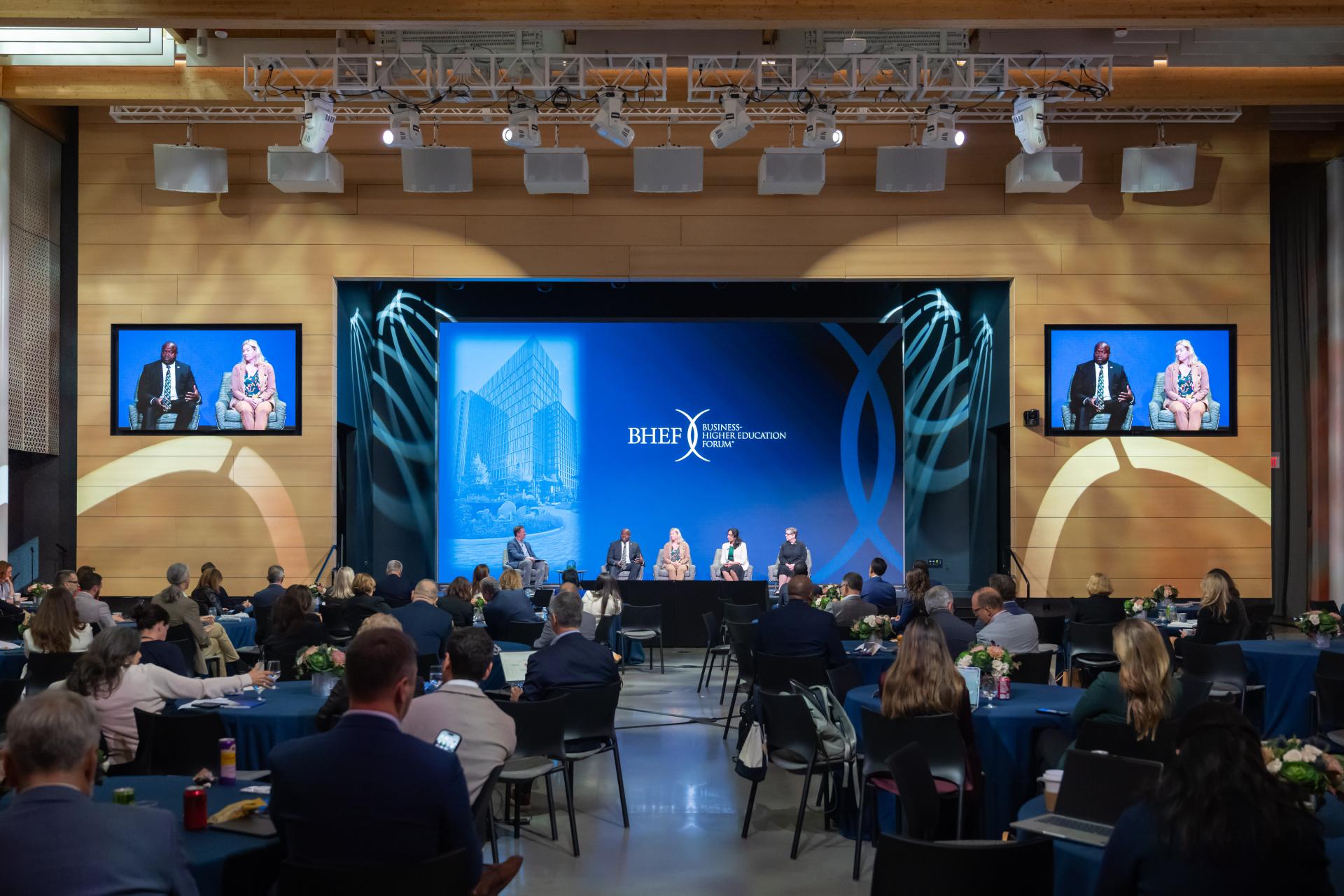
Neither industry nor higher education can rewrite that arrangement alone. That was the premise of BHEF’s 2026 Fall Convening, A New Talent Compact for a Changing Economy, which brought more than 150 business and higher education leaders together to ensure we navigate this moment with the urgency it requires. Industry's message was clear: integrating learning and work is no longer optional. It is a business imperative, and higher education is a critical partner in getting it right.
Our focus was on addressing four challenges that we can only solve together:
- The data gap. We need real-time insight on skills demand, role changes, and which pathways pay off.
- The first rung. Entry-level roles are being transformed, and the informal on-the-job apprenticeship is disappearing, requiring changes to how we educate and develop people.
- The transition gap. Roughly 11 million Americans may need to change occupations and need access to reskilling and upskilling to put their transferable skills to work.
- The proof gap. Durable skills are the new currency, and learners need ways to demonstrate and apply them.
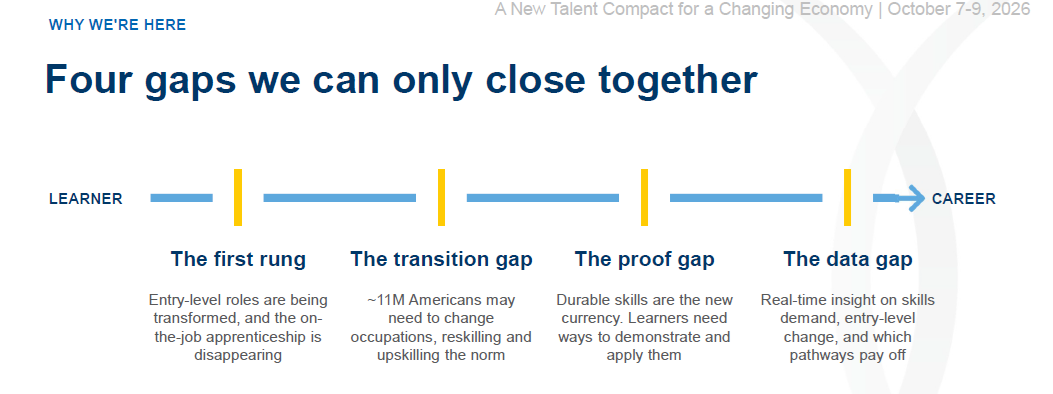
Over the day and a half, the following themes and actions emerged across discussions and working sessions:
1. Work is changing, and so are the skills needed to be successful
Across levels and roles, the tasks within roles are changing. To understand and navigate this, we must collaborate and coordinate across workplaces and educational systems to understand the skills that are needed and how to prepare people for them. This requires a shared language between employers and educators so that we can provide the preparation needed across roles, sectors, and disciplines, and redesign pathways.
There are key sectors where the needs are acute and urgent, including:
- Energy. Talent needs span every education level, from GEDs to PhDs, and data center energy use is expected to double by 2030, with 32 million hires over 10 years.
- National security and space. Skill needs are shifting every three to six months, and graduates are entering jobs that did not exist five years ago.
- Healthcare. One health system that needed about 500 more nurses worked with a university to redesign its curriculum around that need.
Across sectors, learners need exposure to roles they do not know exist and visibility into transferable skills, and regions need coordinated responses rather than one-off programs. To address the data gap and fix the first rung, BHEF and our partners at Aon have been working together on an early-career mapping project to build a shared language that can signal with clarity back to higher education the skills that are needed for high-volume entry-level roles that require postsecondary education and training.
So far, across 27 early-career roles in the financial services, professional services, and life sciences industries, the skills rising fastest in importance are:
- Strategic judgment
- Stakeholder relationships and cross-functional collaboration
- Leadership and people skills
- Ethical oversight
- AI literacy
The road ahead: Through the AI and Future of Talent Collaborative, BHEF helps industry connect strategic workforce planning to the talent pathways that feed it, working with higher education to keep pace with AI-driven change. If your organization is rethinking roles or building talent for AI-enabled work, contact us to get involved.
2. Infrastructure to integrate working and learning is essential, not optional
When people work alongside AI, everyone directs work and is a manager, including the newest hire. That raises the bar for entry-level talent at the same moment the traditional first rung and its historical on-the-job training are disappearing. For employers, this means redesigning the entry-level on-ramp. For higher education, this means building work-integrated learning as essential infrastructure into every student's experience, by design.
From apprenticeship to projects, the proof points and examples are already here:
- One firm makes about 40% of its hires through apprenticeships.
- A decade-old employer apprenticeship program reports 80% retention.
- One university runs 10,000 co-ops a year with 5,000 employer partners.
- Paid, three-week team sprints on real business problems are giving students experience while lowering the burden on employers.
However, while the barriers that prevent employers from scaling these opportunities are real, the positive return on investment is equally real. The risk of not having an early talent strategy is also real. Just like deferring maintenance on capital expenditures, the cost does not show up this quarter, but it does arrive. Leading employers are not cutting early-career roles; they are redesigning the on-ramp and pipelines and looking to new models like apprenticeship and co-designed pathways to do so. As one Fortune 500 talent leader put it, you don’t scale opportunity by adding more seats; you scale it by making real experience the default.
The road ahead: Through our Work-Integrated Learning Innovation Center and Solutions Lab, we are working with higher education institutions and businesses to design, test, and share work-integrated learning models that return real value for businesses and learners. Our business task force is working to define what employers need and to make participation in work-integrated learning easier, especially for small and mid-sized businesses. To learn more and inquire about joining us, contact info@bhef.com.
3. Durable skills are critical in a world where everyone is a manager
Whether in professional services, energy, or defense, the common thread is the same: critical thinking, creativity, collaboration, communication, and the ability to work alongside AI are skills that are needed and transferable across a career. The technical skills change fast. These durable skills do not.
The reason that industry talks so much about durable skills is that they drive real business value that is certainly not “soft.” In his keynote, David Deming, Danoff Dean of Harvard College, shared some of his research demonstrating that companies that undervalue durable skills are leaving value on the table. For example, the ability to read others’ emotions strongly predicts who will be a good teammate. Those who lead people well also lead AI well. These skills can be trained through deliberate practice.
But there is also a new risk to how we learn these skills alongside AI. The risk is that AI removes the productive struggle early-career professionals have always learned from. Think of the classroom as a mental gym: while AI can lift the light weights, learners still need to learn to lift the heavy ones. That means avoiding the extremes of banning AI and making the curriculum all about it. Learners need to learn to do the work both with AI and without it.
Our partners at Wharton’s Generative AI Lab offer a model that reintroduces the productive struggle into an AI-enabled world. Its studio treats AI as a medium for creation, not just a tool, using the following principles:
- Ideas before AI. Participants generate their own ideas first, which makes them more confident going into group work and AI tools.
- Critique at the center. Students present work throughout the process, give peer feedback, and reflect with instructors in a psychologically safe setting. Critique builds the shared vocabulary, discernment, and judgment employers asked for.
- Iteration over output. Projects move through rounds of refinement, building technique and taste.
The result is a mindset shift: from AI as a vending machine to AI as a teammate, and from “we are builders” to “we are directors.” Employers saw direct workplace parallels. New hires need to learn how to give and receive feedback, and organizations need structures for psychological safety.
The road ahead: With significant partner interest, we are planning to create a working group focused on how we test and redesign curriculum for creativity, judgment, and discernment. If you are interested in opting into this working group, contact kristen.fox@bhef.com.
4. Design change together, with urgency and agility
The question is not whether the talent system will change. It is making sure we can meet the moment with the agility required. With roughly 11 million Americans likely to need new occupations, pathways must be ready when people are.
Too much of today’s effort amounts to what one state workforce leader called “random acts of workforce”: good programs with no coordination and no clear owner. Virginia’s response to Amazon’s HQ2 shows the alternative. The state, community colleges, and universities treated it as a regional talent strategy, not a single-company deal, and built it to “lift all boats.” A few lessons stood out:
- Relationships, not transactions. College leaders met with the company regularly and built a working partnership over time.
- Every partner knows its role. A learner can earn an industry cloud credential, convert it to college credit, complete an associate degree, and continue to a bachelor’s, stepping on and off as needed.
- Make it easy for industry. Employers want one point of contact and someone in the room who can translate between industry and education. A request for new skills like AI doesn’t always mean a new program.
- Move at the speed of industry. Start with noncredit offerings and move to credit once approved.
Leaders are already showing what agility looks like:
- Institutions are prioritizing skills, partnering with employers, embedding human and technical skills into learning, and making work-integrated learning part of the student experience.
- Employers are making job redesign a priority and investing in new models for early careers and upskilling.
- Systems and states are providing the infrastructure, best practices, funding, and data that bring it all together.
The road ahead: In moments like this, speed matters. Across our body of work and our network, we’re helping partners identify what works and advance it quickly.
Join us
These takeaways will shape BHEF’s 2027 agenda and are supported by the commitments higher education and business leaders made at the convening. Now comes the real work: moving quickly to turn our network’s collective power into solutions that work for all Americans.
If you are an executive, president, or chancellor ready to help build the talent system our economy needs, join us!