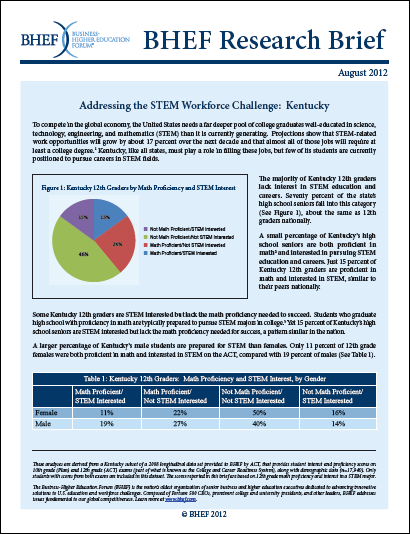
This issue brief explores the STEM workforce challenge in Kentucky, where 70% of high school seniors lack interest in STEM fields.
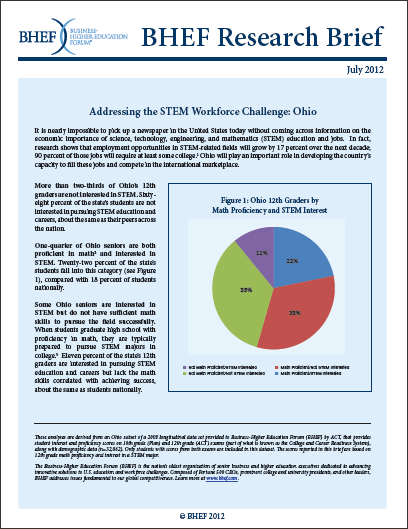
This issue brief explores the STEM workforce challenge in Ohio, where 68% of the state’s students are not interested in pursuing STEM education and careers.
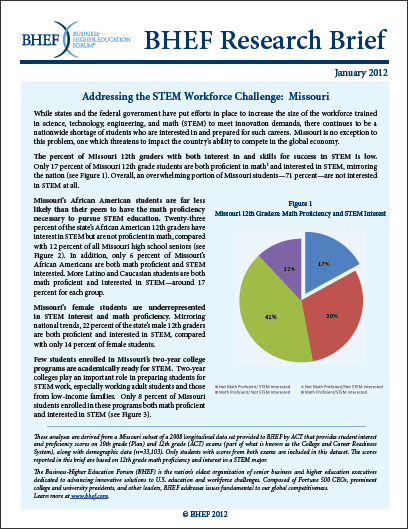
This issue brief explores the STEM workforce challenge in Missouri, where only 17 percent of Missouri 12th grade students are both proficient in math and interested in STEM.
This brief highlights an analysis of 12th grade students’ STEM interest and proficiency, which indicates that current interest in STEM fields and proficiency in math are not sufficient to meet U.S. workforce demand.
This issue brief discusses the untapped potential of STEM-interested (but not math proficient) students in increasing the STEM workforce.
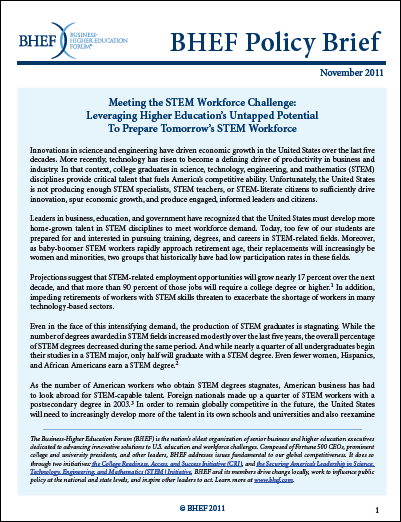
This issue brief discusses the importance of cultivating new STEM talent. Innovations in science and engineering have driven economic growth in the United States over the last five decades. More recently, technology has risen to become a defining driver of productivity in business. In that context, college graduates in science, technology, engineering, and mathematics (STEM) disciplines provide critical talent that fuels America’s competitive ability.
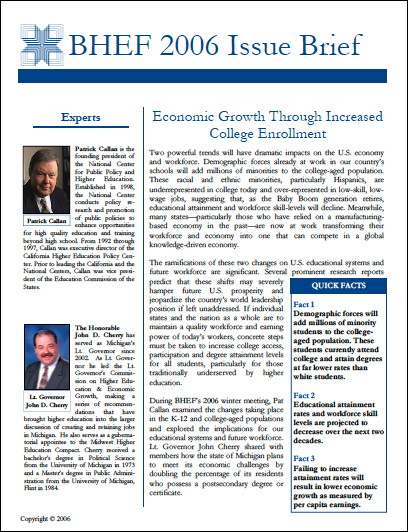
Two powerful trends will have dramatic impacts on the U.S. economy and workforce. Demographic forces already at work in our country’s schools will add millions of minorities to the college-aged population. These racial and ethnic minorities, particularly Hispanics, are underrepresented in college today and over-represented in low-skill, lowwage jobs, suggesting that, as the Baby Boom generation retires, educational attainment and workforce skill-levels will decline.
Experts from Government, Business, and Higher Education Unite on a Key Workforce Need
Washington (December 17) — The Business-Higher Education Forum (BHEF) launched its National Undergraduate Cyber Network at an elite gathering at the Alfred P. Sloan Foundation.
Washington (August 28) —The Business-Higher Education Forum (BHEF), with a $25,000 grant from the Principal Financial Group Foundation, will support their effort to promote the alignment of education outcomes with the needs of the 21st century workforce in Des Moines.
In Des Moines, college and career readiness has been recognized as an essential element to increase the number of the city's talent
Washington (July 30) — The Business-Higher Education Forum, with the support of a $400,000 grant from the William and Flora Hewlett Foundation, will launch a national effort to engage businesses to promote a suite of skills known as "Deeper Learning" that business considers essential to the 21st century workforce.
Integration of the global economy has placed a premium on innovation in the workforce
Pages